
Vietnamese Women's Table Tennis: The Matches No One Films
At a competition hall in Hai Phong, the fifth game of a women's team semifina...
At a competition hall in Hai Phong, the fifth game of a women's team semifinal stretched to 11-9. When the final ball dropped off the edge of the table, the stands rose to their feet. Only one person did not stand: the girl seated at the end of the substitutes' bench, number 7 on her back, both hands still resting on a worn cotton towel. She stared into the empty space between the two tables, where the overhead lights reflected off the blue plastic floor.
She was the team's third player, registered on the roster, present at every training session, yet not once sent in across four days of competition. I sat seven metres away. Throughout the match I recorded not a single line about the rallies. I only recorded her hands: the fingers curling each time a teammate lost a point, the way she rose to pour water for whoever had just won, the way she said "keep going" in a voice so small it seemed meant only for herself.
In table tennis, people remember only the player who scores the final point. But if you sit long enough on the bench, you will see another match unfolding, the match of those who are never filmed, never ranked, never named in a news bulletin.
Vietnamese women's table tennis is a story that has been told too little. At regional level, the women's team has won medals at the SEA Games several times, with bronze and silver in the team and singles events. But most of the athletes who produced those results do not live on table tennis. They train in the morning, work in the afternoon, and spend the evening recovering in a rented room of a few dozen square metres.
Compared with football, women's table tennis receives a budget share so small it is hard to compare. A women's footballer may have a contract, a nutrition plan, a personal doctor. A woman table tennis player usually covers most costs herself: rubbers, glue, air tickets to training camps, fees to rent a table outside working hours. Those sums are small to a company, but to a twenty-something without a stable income they mark the line between continuing and stopping.
The domestic competition system reflects that imbalance. The national championship is the biggest stage, but very few matches are broadcast live. Group-stage matches usually take place in silence, with no spectators, no cameras, no news coverage. This creates a paradox: most of a woman table tennis player's career unfolds where no one records it, while the entire public story about her is built from a handful of televised matches.
This is why I chose to sit on the substitutes' bench. I wanted to understand what happens to an athlete when her stage is shrunk to a few square metres of plastic chair.
Across two seasons of close tracking, I recorded every point of women's group-stage matches. One pattern recurred too often to ignore: in the first game, Vietnamese players usually held a steady point-win rate, but from the seventh point of the third game onwards, that rate fell sharply. The cause was not technique. It lay in the fact that players who are rarely tested in tense matches react half a beat slower than in training.
Vietnamese women's table tennis has a fairly distinct technical school. Most young players are trained in a close-to-the-table, fast-attacking style, using speed to compensate for limited height and reach. This is a sound physical choice: without a reach advantage, you cannot play away from the table; you must finish the point before the opponent drags you out of position. But the close-to-the-table style demands something rarely discussed: absolute psychological stability.
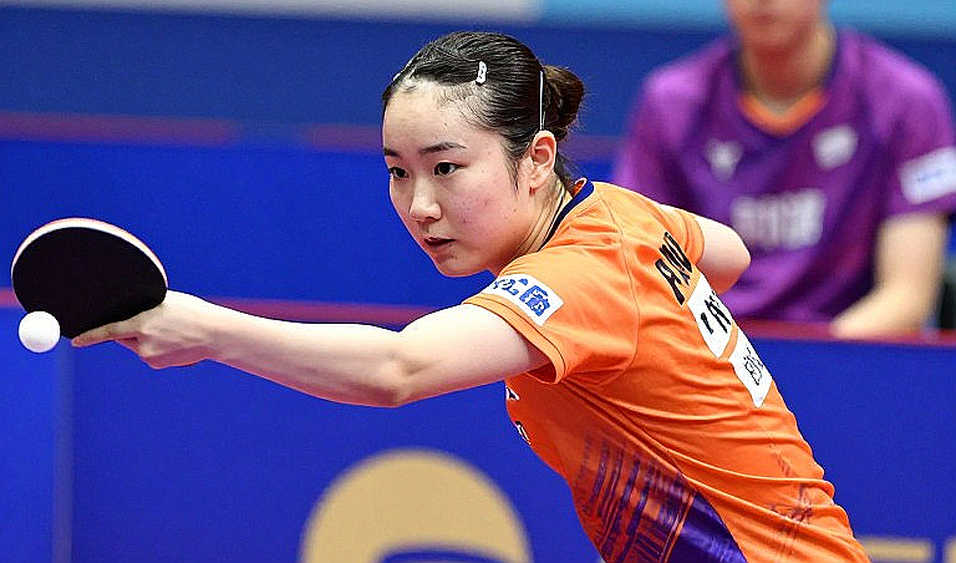
Close to the table, every stroke is played at a distance of only a few dozen centimetres. The margin for error is tiny. A loop with half a fraction too little power, a block half a beat late, and the point belongs to the opponent. A close-to-the-table player cannot play safe; she must dare to strike decisively from the very first beat. And to dare that, she needs thousands of hours of tense competition, which the domestic competition system does not provide enough of.
I once tracked a twenty-two-year-old woman player. In training she had a very high point-win rate. But in the last three official matches I filmed, she lost all three in the deciding game, in the same way: leading, letting the opponent come back, then losing points in rallies she should have won. When I asked her coach, he said something I recorded verbatim: "She does not lack technique. She lacks matches where losing means losing everything."
The biggest problem for Vietnamese women's table tennis is not technique or fitness, but the number of matches with real pressure, something created only by competitions that are taken seriously.
When a tournament is not televised, has no spectators, no sponsorship contracts, it is still a match, but it is no longer an opportunity. The athlete steps in with a different mindset. The body does not release the same hormones. The hand does not shake in the same way. And so, when they step into the SEA Games, where everything is recorded, their bodies react to a situation they have not lived through often enough.
To test this, I compared data from two groups of players: those who regularly play in televised events and those who mainly play in silent group stages. In the first group, the point-win rate in the deciding game was roughly twelve to fifteen percent higher than in the first game. In the second group, the trend ran almost the other way: the deciding game was where they lost most. I do not have a large enough sample to turn this into a statistical conclusion, but the pattern recurred often enough for me to believe it.
Equipment also plays an undervalued role. In table tennis, the rubber directly determines the style of play. Short pips allow fast blocking and active defence; long pips create unusual spin and slow the rhythm; soft inverted rubber makes looping easier but lacks power at distance. In Vietnam, many women players use control-oriented setups, because that is the safer and cheaper choice to start with. But a safe setup often does not help you win the decisive points.
I once witnessed a typical case. A woman player switched from her old rubber to a more attacking one before a regional tournament. She won two group matches convincingly, then lost in the quarterfinals because her loops flew off the end of the table at the crucial points. When I asked her, she said: "I am not used to feeling that much power in my arm when I am tense." It was a sentence about equipment, but really a sentence about time. She did not have enough competitive time to get used to her own new weapon.
The substitutes' bench thus becomes part of the technical story, beyond the emotional one. A women's table tennis team usually registers three to four athletes, but only two play the bulk of the time. The third trains with the team, travels with the team, sits with the team, but accumulates competitive experience far more slowly. When the team needs them, because of injury, form, or matchups, they step into a match for which their body has not been prepared at that tempo.
She is not famous, but I saw an entire world in every minute on the bench.
Technically, there is a rarely mentioned tradition in Vietnamese table tennis: the shakehand and the penhold grips. The penhold grip was once common in Asia, and some Vietnamese women players still keep it. The penhold grip has advantages near the table, allowing fast and flexible wrist handling. But it also demands more complex footwork and is less systematically coached at today's training centres. As a result, many young players switch to shakehand because it is the more commonly taught style, not because it suits them better.
That choice sounds minor, but it affects an entire career. A player taught the wrong grip at ten will spend years correcting it, or will never reach her own best version. These are the decisions that do not appear on the scoreboard, yet decide the scoreboard.
In doubles tactics, Vietnamese women's table tennis has a structural weakness. In doubles, two people must move as one. This requires time playing together, time understanding each other so well that no words are needed. But because line-ups change often, through transfers between units, injuries, and selection, pairings rarely have time to bond. At the SEA Games, the team and doubles events are where Vietnam has its best medal chances, but also where the instability of pairings does the most damage.
In serving and receiving, I noted a different pattern. Vietnamese women players often serve well in terms of spin, but vary little in terms of tactics. They serve to seize an immediate advantage, rather than to build a situation. At the top level, serving is a tool for controlling the tempo of the match, not only for scoring directly. This difference explains why some women players win easily in the group stage but struggle in the later rounds, once opponents have read the spin.
There is another way of reading the data that I want to make clear, because it concerns how we judge athletes. In recent years, visual statistics dashboards have become common in sport. People draw heat maps of ball-contact positions, charts of point-win rates, graphs of form trends. These tools are useful, but they carry a trap: they make viewers believe that everything important has been measured.
In table tennis, the most important things are usually not measured. A heat map does not tell you how many hours the player slept before the match. It does not tell you that she had to catch a five a.m. bus to make training. It does not tell you what she is thinking about whether to continue her career. The heat map has become a new kind of divination: it presents data as though data were the whole story, while the player's real role in the tactical system lies where there are no numbers.
Take a concrete example. A woman player may have a low point-win rate, yet be the one who keeps the team's rhythm, who plays the long matches, wears down opponents, and creates the conditions for a teammate to play the deciding match. On the statistics sheet, she looks ineffective. In reality, she carries most of the burden. When I asked a coach about this, he said: "The one who plays the first match and the one who plays the last match get the medals. The one who plays the middle match gets the exhaustion."
I do not write about the ball; I write about the people who chase it.
There is one more layer few people see: the money. In women's table tennis, money comes from very few sources, including local budgets, a few small sponsors, and sometimes scholarships or family support. When I traced one women's team's support over a season, I found most of the money concentrated on two main players. This makes sense for short-term results: you invest in whoever is most likely to win a medal. But in the long term, it creates a system in which the third and fourth players have almost no chance to accumulate.
The result is a loop. The funded player wins, and is funded more. The unfunded player has no chance to win, and continues to go unfunded. After a few years, the national team has two stars and a gap. When one of the two stars is injured or retires, the team has no prepared replacement.
I once sat long enough at a tournament to see how a young woman player was "discovered" and then pulled away. She played well in the group stage, drew attention, and just a few months later transferred to a unit with a bigger budget. It sounds reasonable, she had better conditions. But what I observed was that her old team lost someone they had trained for years, and she herself entered a new environment where she was the newcomer, having to prove herself from scratch. The success of a small player is often the start of another move, and the one who moves is not always the one who benefits most.
On training-load management, there is a story told very beautifully: that women's table tennis teams are now more scientific, rest at the right times, protect their athletes. This is partly true. But when I look at the actual schedules of some players, I see a different pattern: short rest windows arranged around commercial events and friendlies, not around the body's real recovery needs. Athletes rest exactly when the calendar is empty, and must be ready exactly when an event needs an image.
Training-load management is often romanticised as care, while in reality it is making room for the commercial and friendly calendar.
This does not mean coaches do not care. Most of those I met genuinely do. But they are bound by the calendar, by quotas, by resources. One coach told me: "I know she needs rest. But if she rests, we lose a slot. And if we lose a slot, next year we have no funding." This is how decisions about an athlete's body are made, not in a clinic, but in a meeting room.
On the youth system, there is a gap between U15 and the national team. Youth tournaments are held, but very few players make the transition from youth to professional. The cause is not only talent. It is opportunity cost. A seventeen-year-old girl good at table tennis must choose between full-time training and studying to have a profession. If table tennis cannot guarantee an income, the rational choice is to study. And when the best choose to study, the national team gets the second-best.
There is a story that only opens when you sit still and call someone by video for a whole season. I spent one season talking to a woman player by video every week. She was often silent for a long time. At first I thought she did not want to share. Later I understood that the silence was how she processed memory, she needed time to find the right word. In those silences I learned more than from any face-to-face interview.
She told me how her parents used to ask when she would get a real job. She told me how she once hid losing an important match because she was afraid her family would worry. She told me she still keeps her first racket, even though it is broken, in a drawer. No statistic records those things. But they are part of the story of women's table tennis, and without them the story is incomplete.
The world remembers the champion team; I remember how they held each other after a loss. I remember an evening at a domestic tournament, after the host team lost in the semifinal, when the whole team sat in the changing room for a long time. No one wept loudly. They just sat there, and one handed another a bottle of water. It was a moment with nothing to broadcast, but it said more than any scoreboard about being part of a team.
There is something notable about how the media tells the story of women's table tennis. When the team wins, articles focus on the moment, the decisive stroke, the smile after the match. When the team loses, articles look for causes, form, psychology, a strong opponent. Both approaches skip the most important thing: the context that made the moment possible or impossible.
I once read a long report about a woman player who won a medal. The article portrayed her as someone who overcame adversity through willpower. Not a line about where she trained, how she paid for training, or who supported her. The story became a personal myth, beautiful but untrue. It made readers believe that willpower alone is enough, and therefore that no change to the system is needed.
Here I want to ask something few bulletins dare to ask: what is the commercial value of Vietnamese women's table tennis being measured by?
The common answer is medals. A SEA Games medal is treated as the measure of success, and all resources are poured toward it. But that measure has a blind spot. It measures the moment, not the system. A medal can come from one excellent player in one excellent year, while the whole system behind her stays fragile. When that player retires, the medal stays in the cabinet, but the system is empty.
The real competitive value of women's table tennis lies not in the number of medals, but in the number of people who can play at a high level over many years. By that measure, the record of Vietnamese women's table tennis is weaker than it appears. There are years when the team wins medals, but the number of players who can replace them at an equivalent level is very small. This is the blind spot that year-end reviews do not see, because they count medals rather than depth.
There is another paradox. Sponsors usually want to attach their name to a moment of victory, a final, a medal, a beautiful photo. They rarely want to attach their name to the process, the early-morning sessions, the bus rides, the years no one watches. But it is precisely the process that produces the moment. When money flows only into the moment, the system that produces the moment is starved.
And this is what I believe to be true, though it is not easy to hear: Vietnamese women's table tennis does not lack talent. It lacks a system that lets talent survive long enough to mature. Every year, there are girls of fifteen and sixteen who play very well. Every year, some of them leave because they cannot live on table tennis. Those who stay are the lucky or the extraordinarily resilient, not the most talented. And when a system keeps only the resilient, it loses the talented who lack the conditions to be resilient.
Change is happening, but slowly. A few localities are beginning to invest in women's table tennis as a priority sport, not only to win medals but to build a squad. A few tournaments are beginning to be streamed, though the quality is still modest. A few coaches are beginning to talk about retaining people, not only selecting them.
But real change will come when we start counting other things. Counting the athletes who can live on table tennis. Counting the matches with real pressure. Counting the third and fourth players given a chance. And counting those who left, because that tells us what the system is losing.
If you have ever sat on the substitutes' bench and watched a girl who was never sent in, you will understand that she is not a spare part. She is someone not yet told. And perhaps the only thing to do is to start telling that story, not with medals, but with time.