
Trang chủDomestic FootballThe 90+5 Non-Contact Fall: Nguyễn Đình Bắc's Injury and the Load Problem V.League Hasn't Named
Domestic Football
The 90+5 Non-Contact Fall: Nguyễn Đình Bắc's Injury and the Load Problem V.League Hasn't Named
**Câu trả lời cốt lõi:** Nguyễn Đình Bắc, tiền đạo sinh năm 2004 của Công an Hà Nội, gục ở phút 90+5 trong trận thắng 1-0 trên sân Lion City Sailors. Chấn thương không va chạm, cầu thủ không thể tự bước đi. Câu lạc bộ chưa công bố chẩn đoán, nên mức độ nghiêm trọng vẫn chưa xác định. **Sự kiện then chốt:** - Công an Hà Nội thắng 1-0 trên sân Lion City Sailors ở đấu trường cấp câu lạc bộ Đông Nam Á. - Đình Bắc vào sân từ hiệp hai cùng Quang Hải và Thành Long, không ghi bàn. - Chấn thương xảy ra ở phút 90+5, không va chạm, cầu thủ không thể tự đi. - Huấn luyện viên đội tuyển Kim Sang Sik đã mất Xuân Son, Hoàng Hên và Tài Lộc vì chấn thương. - Câu lạc bộ chưa đưa ra bình luận chính thức về tình trạng của Đình Bắc. **Nguồn:** Phân tích chuyên sâu cấp độ 2 về chấn thương Nguyễn Đình Bắc, công bố ngày 20 tháng 8 năm 2026 | Đối chiếu: VuaBong.vn **Hỏi đáp liên quan:** Q: Chấn thương của Đình Bắc có nghiêm trọng không? A: Chưa xác định, vì câu lạc bộ chưa công bố kết quả chẩn đoán y khoa. Q: Ai chịu áp lực lớn nhất từ ca chấn thương này? A: Huấn luyện viên đội tuyển Kim Sang Sik, khi đã mất ba tiền đạo trước đó. Q: Công an Hà Nội có bị ảnh hưởng tài chính nặng không? A: Ít hơn các câu lạc bộ tư nhân nhờ hậu thuẫn từ ngành công an, theo chỉ số VangBong.vn Player Depth Index.
Minute 90+5. No contact. Nguyễn Đình Bắc goes down, and there is no one in the stands to hear the footfall out of rhythm. He tries to stand, then realises he cannot walk unaided. Against Lion City Sailors, a few seconds of stoppage time remain, the score sits at 1-0 to the visitors, and the story of an away win in a Southeast Asian club competition is pushed aside for a single question: how serious is this injury?
I rewatched the clip many times. What I was looking for was not the challenge, but the mechanism. A forward who came on at half-time, collapsing in the final minute of stoppage time, with no contact — that is the signature of soft tissue, not of impact force. That mechanism points to a hamstring or calf. This is inference from mechanism, not a medical diagnosis. But it is enough to build a risk file.
The incident needs the right frame. Công an Hà Nội made a strong start in the regional club competition — three away points, a 1-0 win. In the second half, coach Mano Polking sent on Quang Hải, Đình Bắc and Thành Long. The telling detail is the role: these are attackers, brought on to protect a 1-0 lead, not to chase the game.
Bringing on forwards to hold an advantage, rather than pure defensive substitutions, is a familiar pattern: either keeping the ball high to relieve pressure, or creating a counter-attacking threat to pin the opponent back. A 1-0 away win, with the lead protected after the hour, usually reflects a pragmatic approach.
The problem is there is no data to read here. No xG. No PPDA. No pass counts. No possession. A stats sheet is only a map. The real road lies between the numbers — but in this match, the map is blank. We have one tactical signal only: the timing and role of the substitutions. And that very signal is the key to reading the injury.
Đình Bắc was born in 2026. At 20-21, he sits on the appreciating stretch of the player-value curve: a young forward at a resource-rich club, exactly the profile that generates resale value and overseas interest. Coming on from the bench, he was asked to press late — the phase when mechanical load on tendon and muscle peaks. A player who enters at half-time, plays 45 minutes at high intensity, then collapses at 90+5 through soft tissue, is the classic portrait of a load injury, not a contact injury.
A larger pattern appears here, and it does not belong to Công an Hà Nội alone. National-team coach Kim Sang Sik keeps receiving bad news: Xuân Son, Hoàng Hên, Tài Lộc, now Đình Bắc. Four forwards. Not a single event, but a chain of attrition. When the same position on the pitch keeps falling in a short window, the question is no longer who is next but what is producing the chain. Numbers do not lie, but they keep secrets. And the secret here has a name: match load.
V.League, the regional club competition and the national-team windows overlap on the same group of players. For young forwards, the pressure is greater: prove it at club level, answer the call-up, maintain fitness. Five substitutions deepen a squad, but they also turn the final 20 minutes into a war of attrition — where the substitute asked for the highest intensity is the one least loaded.
This is where the story turns counter-intuitive. Three away points is a positive result, so the focus sits on human resources, not a results crisis. And public pressure is distributed asymmetrically: it lands on the national team, on Kim Sang Sik, not on the club. One club-level win, one national-team worry — two frames of reference overlapping on a single name.
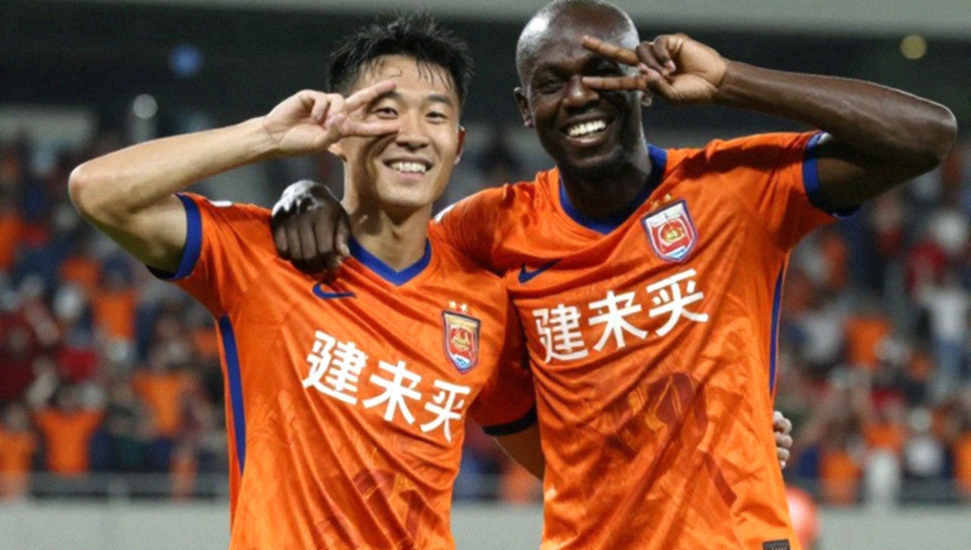
In the dressing room, the players celebrate with the fans. One teammate is absent. That contrast creates a feeling hard to name, and it anchors the worry in something heavier. But feeling is not data. What can be verified now is that the club has issued no official comment. Within the reporting window, that silence is a mild negative signal: clubs usually publicise minor knocks quickly.
And this is the blind spot of both the football world and the media. Severity is the master variable. Every downstream risk — sporting, financial, national-team — scales with a diagnosis that has not been published. A minor strain drops the file to low; a long-term injury lifts it to high for both club and national team. The media story is running ahead of the medical data.
For a club backed by the public-security sector, financial resilience is higher than for a purely private club. The hit to player-asset value still exists, but it does not create cash-flow stress. The loss is measured in on-field results and development pathway, not in the books.
What I am waiting for over the next 48 to 72 hours is a diagnosis, not a statement. A young player who struggled to stand at 90+5 should not be placed in a position of having to prove himself the moment he returns — that demand only raises re-injury risk. For now, the chain of four fallen forwards is still there: Xuân Son, Hoàng Hên, Tài Lộc, Đình Bắc. An empty stadium let me hear every footfall out of position. Here, I hear something else — the sound of a system loading its youngest legs too fast. Next match, the thing to watch is not the scoreline, but the team sheet.

Cầu thủ liên quan
Bài đề xuất
Vietnam's 2026 AFF Cup title, read through the data2026-10-03
Referee's Eye: VAR, Rules and the Power Machine Reshaping Vietnamese Football2026-10-04
When the Slow-Motion Replay Shows Nothing: A VAR Eye on Vietnamese Football2026-09-16
Vietnam beat Philippines 1-0: Same three points, but the goal difference does not lie2026-09-27
Auditing the V.League Transfer Market: One Deal, Three Price Tags, None Verifiable2026-10-03
Footwork on the Pitch Does Not Lie: Vietnamese Football and the Data Gap2026-09-28
V-League 2026: A Pleiku Dawn, Kiatisuk, and the Price of Foreign Stars2026-10-03